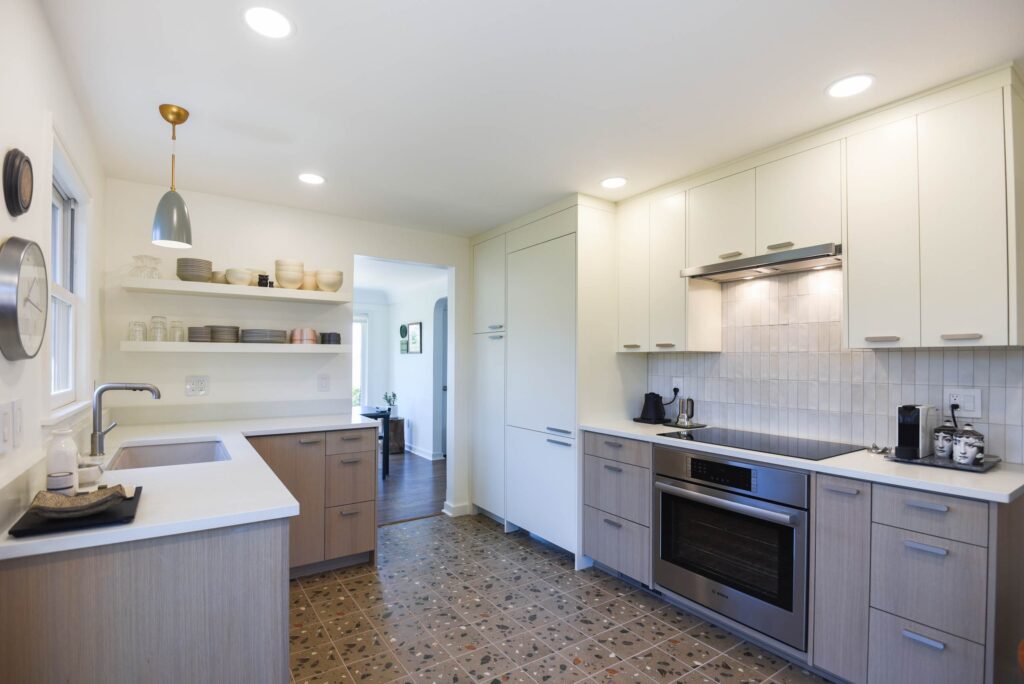
A midrange remodel replaces what is there. Luxury means redrawing how you cook, store and move through the room, on paper, weeks before demolition. Here are nine places where the two split apart, from design hours to who answers after final inspection.
A luxury kitchen remodel differs from a standard one in how much of the job is designed, built to order and coordinated, not only in the price of the finishes. At Maksymov Brownstone we draw the line at our upscale, custom tier: custom cabinetry, slab stone, professional-grade appliances and structural work, typically $150,000 to $300,000+ and 12 to 20 weeks of construction, with Washington sales tax included. A standard kitchen, in our terms, is the mid-range tier: $45,000 to $85,000 and 4 to 7 weeks of construction. Both ranges come from our own Seattle projects and are published in our 2026 kitchen cost guide.
What do people mean by “luxury,” and what do we mean?
The word gets used loosely. Ask ten homeowners and you hear marble, a restaurant-style range, a wine fridge. Those are products. They can sit in a kitchen that works badly, and we have seen expensive appliances installed in layouts where the cook has to walk around the island to reach the sink.
So here is the definition we work with. A kitchen is luxury when its layout, cabinetry, surfaces, lighting and ventilation are drawn together before demolition and built by one accountable team. The money still matters, but it is the result of that planning, not the starting point. That is also why the gap between a standard and a luxury kitchen shows up first on paper, in the design stage, long before anyone swings a hammer.

How much more does a luxury kitchen cost in Seattle?
Start with an outside source. Zonda, a housing-data firm, publishes an annual report called Cost vs. Value, which models what typical remodeling projects cost and how much of that cost comes back when the house is sold. These are modeled figures, not quotes. In the 2025 edition for Seattle, a midrange major kitchen remodel costs $95,542 and an upscale one costs $188,401. Going from one to the other adds $92,859 of cost and $22,209 of resale value. By our calculation, that is about 24 cents back for every extra dollar, or roughly $239 for every extra $1,000. Midrange recoups 53.1% of its cost at resale; upscale recoups 38.7% (Zonda Cost vs. Value 2025, Seattle).
Two cautions. First, Zonda’s “upscale” is a standardized scope, not our definition, so use it as a direction rather than a price for your kitchen. Second, homeowners report different numbers again. In its 2026 Kitchen Trends Study, a self-reported survey of 1,780 homeowners, Houzz found a median major kitchen remodel of $55,000, $75,000 for kitchens of 250 square feet or more, and $150,000 at the 90th percentile (Houzz). We break down why these numbers disagree in our luxury kitchen cost article.
Our view, stated plainly: a luxury kitchen is built to live in, not to flip. If resale is the main goal, the data points to the midrange tier. If you plan to stay for years and cook in the room every day, the extra money buys things that show up daily and never appear on a listing sheet.
What is the difference between a luxury and a standard kitchen remodel?
In this table, “standard” is our mid-range tier ($45,000 to $85,000) and “luxury” is our upscale, custom tier ($150,000 to $300,000+). The last column gives an outside source for each row.
| Row | Standard remodel | Luxury remodel | Evidence |
|---|---|---|---|
| Design process | Design, drawings and specifications are about 4% of a $70,000 budget | 3D renderings, showroom visits with a designer, a written specification book; a $500–$1,500 structural report when a bearing wall moves | Houzz (self-reported): 34% of $50,000+ projects hire a kitchen designer vs. 22% overall |
| Cabinetry | New semi-custom cabinetry | Custom cabinetry: from about $500 per linear foot installed, 8–14 week lead time | Houzz: custom 46%, semi-custom 33%, stock 10% |
| Appliances | Full appliance package | Professional-grade appliances; ask whether the cabinet maker panels or integrates them | Houzz: 20% put cabinet panels on some or all large appliances |
| Surfaces | Quartz counters, tile backsplash | Slab stone, waterfall edges | Houzz: engineered quartz 32%, granite 15%, quartzite 10%, marble 3% of countertops |
| Lighting | Upgraded lighting and electrical | Layered plan: ambient, task and accent | Houzz: recessed 72%, under-cabinet 72%. Washington’s Energy Code requires high-efficacy fixtures (WSR 22-17-149) |
| Layout and structure | Same footprint, walls stay | Structural work, sometimes an addition | Houzz: 52% change the layout; 32% enlarge the kitchen |
| Ventilation and utilities | Hood replaced; hidden wiring or plumbing problems turn up at demolition, so we advise a 10–15% contingency | Ducted ventilation and utilities planned in the design; a statement hood | Washington code (WAC 51-52-0403): hood over an electric range 160 cubic feet per minute (cfm) or 65% capture efficiency; over a gas range 250 cfm or 80% |
| Project management and permits | Permit-legal scope, 4–7 weeks of construction | Structural engineering, city plan review, 12–20 weeks of construction | Seattle Department of Construction and Inspections (SDCI): projects beyond a simple permit go through plan review (SDCI) |
| Warranty and documentation | Written 3-year workmanship warranty | Same warranty, plus a specification book and as-built drawings if the layout changed | Our warranty page |
A word on “plan review,” since it appears twice. Plan review means a city examiner reads your drawings before issuing the permit. It is slower than the simplified permit small projects can use, and it is one reason luxury kitchens take longer. We cover the clock in how long a luxury kitchen remodel takes.
Where does the extra budget actually go?
Here is how a $70,000 mid-range budget splits in our model. We publish this split for the mid-range tier only; an upscale budget shifts toward cabinetry, stone and structural work, and we do not claim a fixed split for it.
| Category | Share | Dollars at $70,000 |
|---|---|---|
| Cabinetry and millwork | 30% | $21,000 |
| Labor | 25% | $17,500 |
| Appliances | 12% | $8,400 |
| Countertops and backsplash | 10% | $7,000 |
| Plumbing and electrical | 8% | $5,600 |
| Flooring | 6% | $4,200 |
| Lighting and hardware | 4% | $2,800 |
| Design, drawings and specifications | 4% | $2,800 |
| Permits and disposal | 1% | $700 |
Washington sales tax at Seattle’s 10.55% combined rate adds $7,385 on top of a $70,000 contract (verify the rate for your delivery address, since the Eastside differs).
Design time. Design takes about three weeks per room at our firm. Luxury projects spend more of it because there is more to settle: renderings, showroom visits, a specification for every finish. The reason to front-load it is simple arithmetic. A change after the cabinets are ordered costs more than the same change on paper.
Cabinetry. Cabinetry and millwork take 30% of the mid-range budget, and cabinetry plus labor take 55%. Custom starts at about $500 per linear foot installed. “Custom” is already common (46% of renovating homeowners in Houzz’s survey), so the word alone does not separate luxury. What the box is made of, how the drawers are built and whether the run was drawn to your walls does. More in custom vs. semi-custom vs. stock cabinets.
Layout, structure and air. Moving a wall means a structural engineer’s report ($500 to $1,500) and often city plan review. Ventilation changes with the range, and a statement hood still has to meet the code numbers in the table. The National Kitchen & Bath Association (NKBA), the industry’s standards body, recommends ducted ventilation of at least 150 cfm (NKBA Kitchen Planning Guidelines).
Who is accountable. We run design, permits and construction as one team, with a dedicated project manager giving regular updates. Luxury adds coordination, not only materials: more trades, longer sequences, more places for a gap to open between the drawing and the build.

What do clients say about the price?
“The price for the level of design, service, craftsmanship and detail you experience is well worth it. We went with custom cabinetry and are still in awe of how perfect everything has lined up.”
Michael M., November 2025, Google review
Another client, Nicholas A. (January 2026, Google review), wrote that “the kitchen we got was nearly identical to the kitchen originally pitched in the design docs, which I feel is quite rare.”
Which tier fits your kitchen?
There is no shame in the midrange tier, and we say that as a company that builds both. Use these rules of thumb.
- Midrange fits when the footprint stays, the walls stay, and the goal is new cabinets, counters, appliances and lighting in the same room. You get a finished, durable kitchen in 4 to 7 weeks of construction.
- Upscale fits when you want to move or remove a wall, add square footage, draw cabinetry to odd walls or integrate appliances behind panels. In Houzz’s survey 52% of renovating homeowners changed the layout and 32% enlarged the kitchen, so this is common, but it is also where cost and schedule jump.
- Neither fits yet if you cannot say how you cook, how many people use the room at once, or what annoys you today. Answer those first. A good designer will ask the same questions in the first meeting.
What should you ask before choosing a tier?
- Who draws the layout, and will I see renderings before anything is ordered?
- What are the cabinet boxes made of, and how are the drawers built?
- Are the appliances panel-ready, and who builds the panels?
- Is a bearing wall involved, and does the price include the engineer’s report?
- What contingency do you advise for a house of this age?
- Who is my single point of contact after final inspection?
If a contractor cannot answer these before you sign, the quote is not detailed enough to compare.
What does our own work look like?
Two published projects show the detail side. The University District kitchen took four weeks and reworked a compact room for storage, circulation and lighting. The Green Lake Scandinavian kitchen took one month. On our design page, a Seattle kitchen pairs light oak flat-panel custom cabinetry with black linear hardware. We do not publish per-project prices, so we attach none here; the ranges above are the honest picture.
Next step
If you are weighing tiers for your own kitchen, start with a complimentary consultation. You get a preliminary range at that meeting and an itemized estimate once the design is final. Book through our kitchen remodeling page.