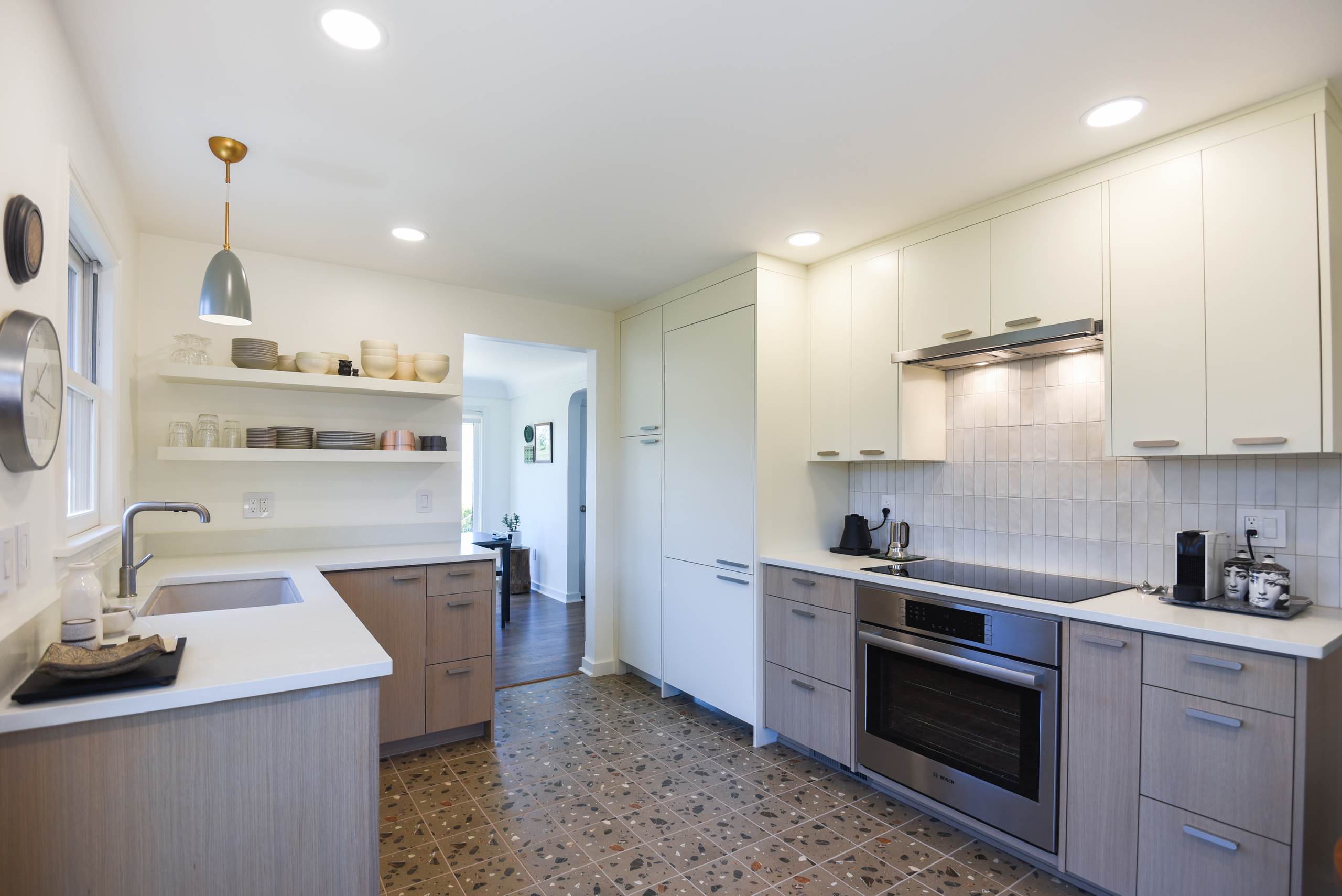

Houzz found 46% of renovating homeowners chose custom cabinets and 10% chose stock, so the label no longer tells you much. Ask what the box is made of, how the drawers are built and whether the run was drawn to your walls. Then ask about the 25% tariff on imported cabinets.
Stock cabinets come in factory-standard sizes, semi-custom cabinets add set size and finish options, and custom cabinets are built to the room. Installed, stock runs about $100 to $300 per linear foot, semi-custom $180 to $450, and custom from about $500. (A linear foot is one foot of cabinet run along the wall.) At Maksymov Brownstone we focus on custom cabinetry for full remodels: 3/4-inch plywood boxes, inset or full-overlay doors, European hardware and more than 1,500 finishes. Semi-custom is the sensible step down when the layout is standard and the budget is fixed.
What is the difference between custom, semi-custom and stock cabinets?
| Factor | Stock | Semi-custom | Custom |
|---|---|---|---|
| Sizing | Fixed standard sizes | Set size increments | Built to the room |
| Typical lead time | 1–2 weeks | 4–8 weeks | 8–14 weeks |
| Installed cost per linear foot | $100–$300 | $180–$450 | From about $500 |
| Box material | Particleboard | Particleboard or plywood | Plywood standard (ours: 3/4-inch) |
| Finish options | 8–15 | 20–50 | Unlimited (we offer 1,500+) |
| Best for | Rental units, quick flips | Budget-conscious remodels with standard layouts | Long-term homes, full remodels |
Source: our cabinet guide (updated June 29, 2026) and 2026 kitchen cost guide. Our two guides give different prices for some tiers; the semi-custom figure here is from the newer cost guide. Custom starts near $500 per linear foot installed in both.
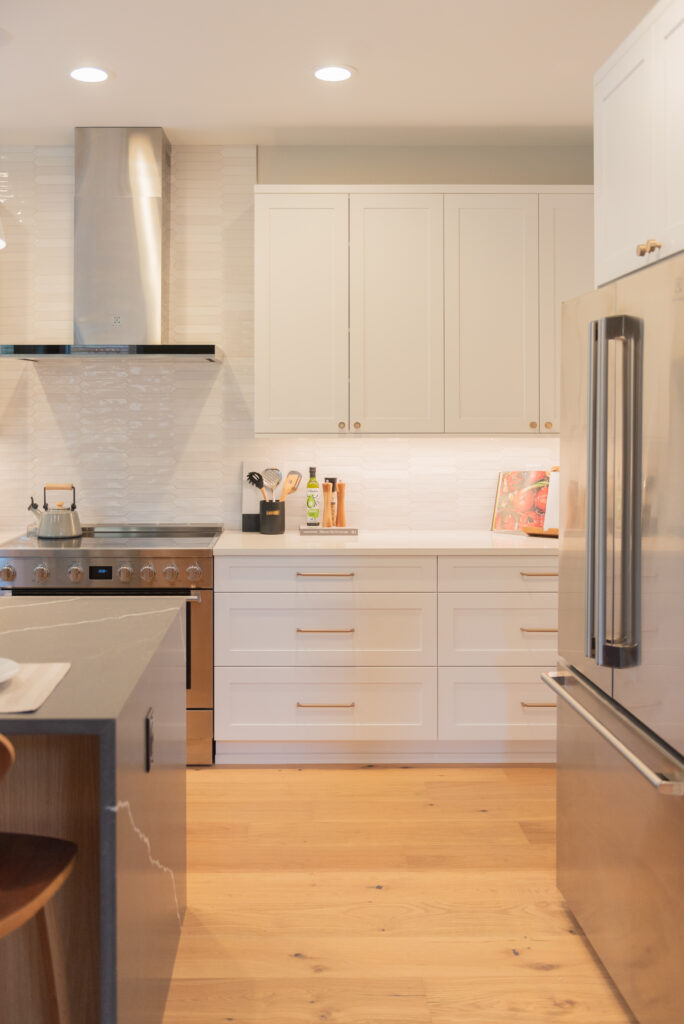
What does that mean in dollars for a real kitchen?
Take a kitchen with 20 to 25 linear feet of cabinets. Multiplying our published per-foot ranges gives the following (our calculation, cabinetry only, installed):
| Type | 20 linear feet | 25 linear feet |
|---|---|---|
| Stock ($100–$300 per foot) | $2,000–$6,000 | $2,500–$7,500 |
| Semi-custom ($180–$450) | $3,600–$9,000 | $4,500–$11,250 |
| Custom (from $500) | From $10,000 | From $12,500 |
Two things to keep in mind. These are cabinet costs only, before countertops, appliances or work beyond installation. And custom has no published ceiling here because the finish, the hardware and the complexity of the run all move the price. Treat the custom row as a floor, not a quote.
How many homeowners actually choose each type?
Houzz’s 2026 Kitchen Trends Study, a self-reported survey of 1,780 homeowners, shows the market has moved up. Respondents define “custom” themselves, so read it as “homeowners report choosing custom cabinetry,” not as a technical standard.
- Custom 46%, semi-custom 33% (79% together), stock 10%, ready-to-assemble 9%.
- Solid-wood fronts 71%, with maple the leader at 39%. A painted finish is used by 52%.
- Wood tones (29%) now edge out white (28%) as the top cabinet color.
- 94% of upgraded cabinets include built-in specialty storage; pull-out waste or recycling is the most common (64%).
Source: Houzz 2026 U.S. Kitchen Trends Study (PDF).
Is custom cabinetry worth it?
When you plan to stay and the room is not a standard rectangle, yes. A custom run fills odd walls, uses a 3/4-inch plywood box and includes storage you specify rather than storage the catalog offers. When the layout is conventional and the budget has a hard ceiling, semi-custom with plywood boxes gets most of the function. Stock makes sense for a rental or a quick sale.
The mistake we see in estimates is comparing a custom quote with a stock one as if the box and the drawers were the same thing. They are not. Ask for both quotes with the box material and drawer construction written in.
Here is what we publish about our custom cabinetry: inset or full-overlay doors, European hardware systems and more than 1,500 finishes (custom cabinetry page); 3/4-inch plywood boxes, dovetail or dowel drawer boxes and full-extension soft-close slides (cabinet guide). We publish no hardware brand names or per-project cabinet prices, so none appear here.
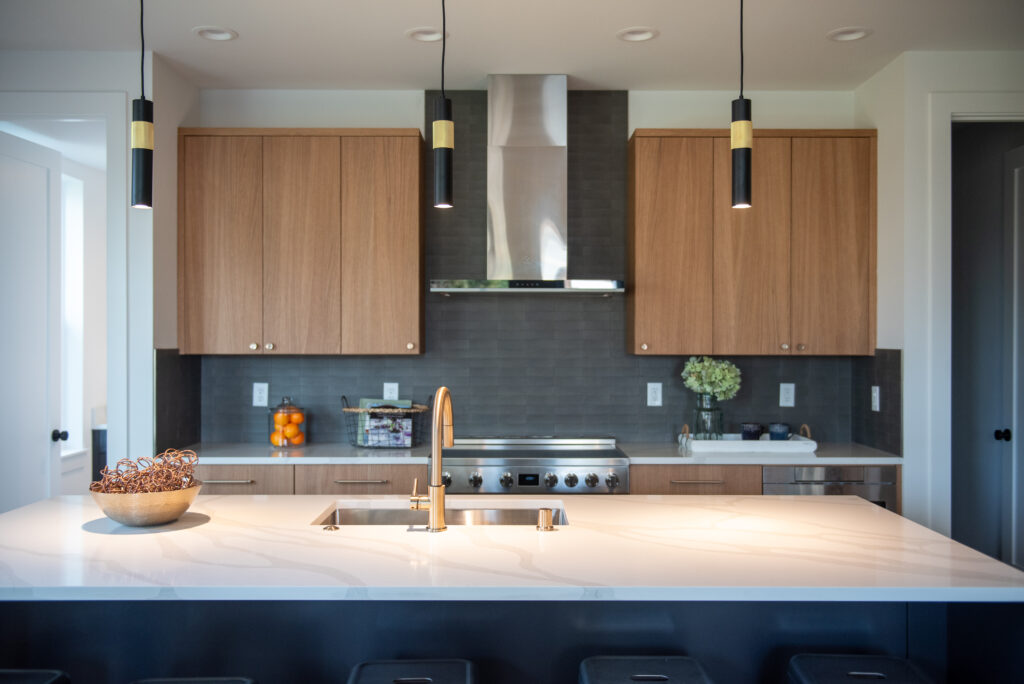
Which type fits your project?
- Choose stock when the kitchen is a rental, a quick flip or a short-term fix, and a 1–2 week lead time matters more than fit.
- Choose semi-custom when your layout is standard, you want plywood boxes and some finish choice, and the budget is fixed.
- Choose custom when you are staying, when walls are uneven or the ceiling is irregular, when you want specific storage, or when you are already moving walls and plumbing, so the cabinets can be drawn around the new layout.
What do clients say about custom cabinetry?
“We got 100+ sqf addition so now our kitchen is bigger than before. Also they made this custom cabinets.”
Sergei F., 2024, Google review
A second client, Michael M. (November 2025, Google review), put the trade-off this way: “We went with custom cabinetry and are still in awe of how perfect everything has lined up.” An addition is the case where custom matters most, because there is no standard cabinet size for a room that did not exist before.
Do tariffs affect cabinet prices?
Possibly, for imported lines. Since October 14, 2025, a 25% Section 232 duty applies to imported kitchen cabinets, vanities and their parts. (Section 232 is the trade law that lets the U.S. government tax imports for national-security reasons.) The duty is scheduled to rise to 50% on January 1, 2027, except for countries that reach a trade agreement with the United States. Parts are covered too, so imported components of a domestically assembled cabinet may be affected (Federal Register, Proclamation 11000; U.S. Customs and Border Protection guidance).
This is information, not buying advice. Ask each supplier where a line is made, whether hardware, stone and appliances are imported, and how a duty change is handled in the contract. Our published practice is stage-based payments, regular cost updates and a written change order before any change of scope (renovation guide). We publish no tariff clause, so we do not claim one.
What should you ask a cabinet maker?
- What are the boxes and drawer boxes made of?
- Are the slides full-extension and soft-close?
- Is the run drawn to my measured walls, and who measures?
- What is the lead time from approved drawing to delivery?
- Where is each line made, and how is a duty change handled?
- Who installs, and who fixes a door that is out of line?
Next step
Bring your floor plan and a rough budget to a complimentary consultation, and we will show you which type fits. See our custom cabinetry or book through the kitchen remodeling page.


