
Most Seattle homeowners start with a national number and end up recalibrating. The 2026 U.S. Houzz Kitchen Trends Study puts the median major kitchen remodel at $55,000 nationally — $75,000 for kitchens over 250 square feet, $46,000 for smaller ones. In Seattle, the same scope routinely lands 20–35% higher before a single upgrade is chosen. A large part of that gap has nothing to do with taste: Washington applies retail sales tax to the entire remodeling contract, and Seattle’s combined rate is 10.55%.
This guide breaks down what that means in dollars — line item by line item, tier by tier — using 2026 pricing from projects we build across Seattle and the Eastside.
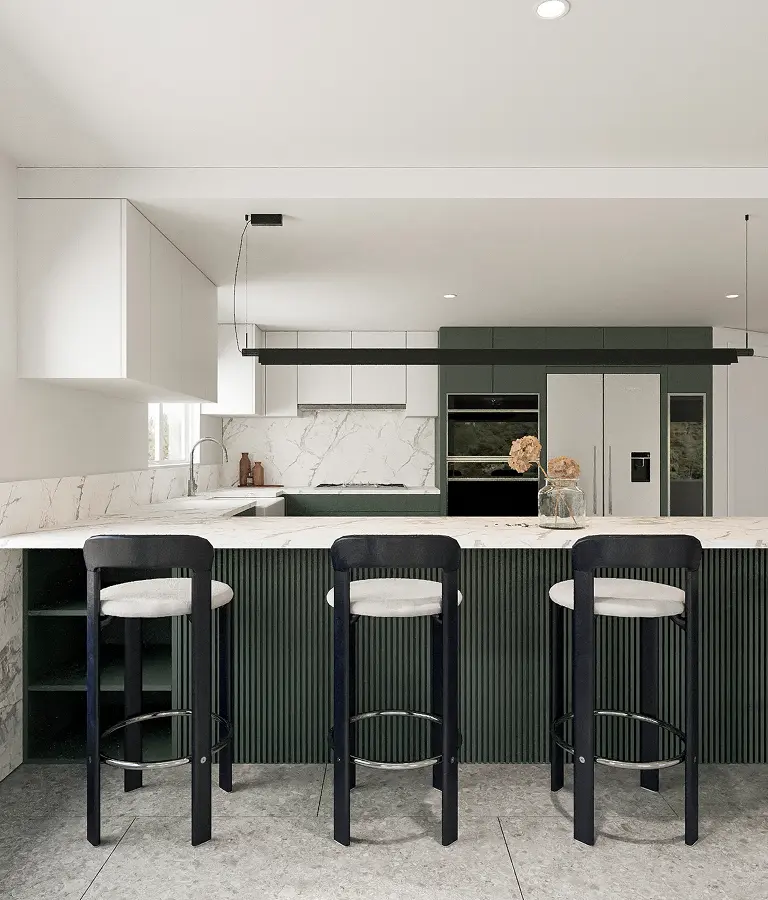
Quick Answer: Seattle Kitchen Remodel Costs In 2026
These are the ranges we quote for a typical 150–250 sq ft Seattle kitchen. They include labor, materials, project management, and Washington sales tax, but exclude structural additions.
| Scope | Seattle Range (2026) | Typical Timeline |
| Cosmetic refresh — refacing, counters, hardware, paint, no layout change | $18,000 – $35,000 | 2–3 weeks |
| Mid-range full remodel — new semi-custom cabinets, quartz, appliances, same footprint | $45,000 – $85,000 | 4–7 weeks |
| Major remodel — wall removal, relocated plumbing/electrical, new layout | $85,000 – $150,000 | 8–14 weeks |
| Upscale / custom — custom cabinetry, slab stone, pro appliances, structural work | $150,000 – $300,000+ | 12–20 weeks |
For reference, the average kitchen remodel cost Seattle homeowners report at $33,297, with a typical range of $17,174–$46,648. That figure skews low because it blends cosmetic refreshes and partial jobs into the same pool as full remodels — useful as a floor, misleading as a plan.
On a per-square-foot basis, finished Seattle kitchens generally run $225–$700 per sq ft, and cabinetry alone runs $180–$450 per linear foot for semi-custom, or $500–$1,100 per linear foot for true custom millwork.
Three Local Factors Behind The Cost Of Kitchen Remodel Seattle Quotes
National averages assume national conditions. Three things explain most of the gap between those averages and the cost of kitchen remodel Seattle homeowners see on a signed contract.

1. Washington Taxes Labor, Not Just Materials
This surprises almost every client who has remodeled in another state. Per the Washington Department of Revenue construction guide, the taxable amount on a custom construction job includes charges for permits and other fees, labor, profit, materials and subcontractor charges. Everything.
At Seattle’s 10.55% combined rate, a $70,000 kitchen contract carries $7,385 in sales tax. That is not a rounding error — it is roughly the cost of your appliance package.
Practical takeaway: when you compare quotes, confirm in writing whether the number is tax-inclusive. Two bids that look $7,000 apart may be identical.
2. Seattle Permits Are Value-Based And Slower Than You Think
Cosmetic work — paint, countertops, cabinets going back in the same location — generally does not require a permit. Anything touching structure, plumbing relocation or new electrical circuits does.
SDCI fees are calculated from project valuation, so a bigger budget means a bigger permit bill. In practice, a full Seattle kitchen permit package (building plus electrical plus plumbing) commonly lands between $800 and $2,500. Current fee schedules are published on SDCI’s permit cost page. Simpler interior remodels can often use the faster Subject-to-Field-Inspection track; anything structural goes to full plan review, and you can track current turnaround on SDCI’s permit performance dashboard.
The real cost of permitting is rarely the fee. It is the weeks of review time you did not budget for.
3. Cabinet Tariffs Are Still In Effect — But Not At The Rate Most Articles Claim
Since October 14, 2025, imported kitchen cabinets, vanities and their component parts have carried a 25% Section 232 tariff. Many cost guides published in late 2025 warned that the rate would jump to 50% on January 1, 2026. It did not. That increase was delayed by proclamation until January 1, 2027.
So: 25% is live now, the 50% step is a 2027 risk, and Chinese-origin cabinetry can stack well beyond that once existing duties apply. If you are choosing between imported and domestically built cabinetry, that timeline matters more than the sticker price. We manufacture our custom cabinetry in-house precisely so client budgets are not hostage to a proclamation — and we’ve written separately on whether custom cabinets are worth it.
Where The Money Actually Goes
Here is how a $70,000 mid-range Seattle kitchen typically allocates, before sales tax:
| Line Item | Share | Dollars |
|---|---|---|
| Cabinetry and millwork | 30% | $21,000 |
| Labor — demo, carpentry, tile, drywall, paint, PM | 25% | $17,500 |
| Appliances | 12% | $8,400 |
| Countertops and backsplash | 10% | $7,000 |
| Plumbing and electrical trades | 8% | $5,600 |
| Flooring | 6% | $4,200 |
| Lighting and hardware | 4% | $2,800 |
| Design, drawings, specifications | 4% | $2,800 |
| Permits and disposal | 1% | $700 |
| Subtotal | 100% | $70,000 |
| Washington sales tax at 10.55% | — | +$7,385 |
| Total to the homeowner | — | $77,385 |
Two observations worth acting on. First, cabinetry and labor together are 55% of the budget — decisions there move the number far more than which faucet you pick. Second, design is not where you save. A $2,800 design phase that prevents one mid-build layout change usually pays for itself twice over.
What Each Budget Tier Actually Buys

$18,000 – $35,000 — the cosmetic refresh. Cabinet refacing or repainting on sound boxes, quartz or butcher-block counters, new sink and faucet, backsplash, LVP or refinished flooring, updated lighting. Layout and plumbing stay put. Roughly two-thirds of homeowners nationally keep their kitchen footprint unchanged, and this tier is why.
$45,000 – $85,000 — the honest mid-range. This is where most Seattle projects land. A modern kitchen remodel cost in this range covers new semi-custom cabinetry, quartz counters, a full appliance package, tile backsplash, new flooring, upgraded lighting and electrical, and a permit-legal scope — without moving walls. Houzz found that 76% of renovating homeowners add built-in features here, with pantry cabinets (47%) the single most common.
$85,000 – $150,000 — layout changes. Removing a wall between kitchen and dining room, relocating the sink or range, adding an island with plumbing or power, upsizing windows. Structural work in Seattle also means engineering: a stamped structural report for a load-bearing wall removal typically adds $500–$1,500 before construction starts.
$150,000 – $300,000+ — custom and structural. Custom cabinetry, slab stone with waterfall edges, professional-grade appliances, integrated lighting design, and often a home addition to expand the footprint. One of our Seattle-area clients added over 100 square feet to the kitchen and paired it with custom cabinets — a different project category, and priced accordingly.
Real Seattle Projects, Real Scopes
Numbers are easier to read against actual work. Two kitchens from our case studies:
Green Lake, Seattle — Scandinavian kitchen. An outdated kitchen rebuilt around minimalist proportions and storage that actually works. Duration: one month. The layout was refined rather than relocated, which is exactly the choice that keeps a project in the mid-range tier instead of the structural one.
University District, Seattle — contemporary urban kitchen. A compact, dated kitchen with limited workspace. We reworked storage, circulation, and lighting. Duration: four weeks. Small kitchens are not proportionally cheap — cabinetry, trades and permits do not shrink linearly — but they do finish faster, which reduces the cost of living without a kitchen.
More before-and-after work is in our portfolio.
The Line Items That Blow Up Seattle Budgets
Seattle’s housing stock is old, and old houses hide things behind cabinets. Budget a 10–15% contingency and expect at least one of these:
- Knob-and-tube or ungrounded wiring — discovered at demo; a kitchen circuit rebuild runs $3,000–$9,000.
- Galvanized supply lines — brittle, corroded, and code-problematic once you open the wall. Repiping a kitchen run: $2,000–$6,000.
- Asbestos-containing sheet flooring or mastic — common in pre-1985 homes. Testing is inexpensive; abatement is not ($1,500–$5,000).
- Failing subfloor — often under old dishwashers and sinks. $1,500–$4,000.
- No exterior venting for the hood — recirculating hoods are frequently swapped for ducted ones, requiring a new roof or wall penetration.
- Structural surprises — a wall you assumed was a partition turns out to be bearing.
A contractor who quotes an older Seattle home with no contingency line is not giving you a better price. They are giving you a worse forecast.
Does It Pay Back?
Nationally, the 2025 Cost vs. Value Report found that a midrange minor kitchen remodel averaged $28,458 and returned $32,141 in resale value — about 112.9% recouped, and the only interior project in the national top five. A midrange major kitchen remodel averaged $82,793 with roughly $42,130 recouped, and an upscale major remodel averaged $164,104 returning around $58,561. Zonda also reports the Pacific region among the strongest-returning regions in the country.
The pattern is consistent: percentage return falls as scope grows, while total dollars added keep rising. A refresh is an investment decision. A gut remodel is a lifestyle decision that also happens to add value.
For Seattle specifically, Redfin reported a median Seattle sale price of about $879,000 for the three months ending May 2026. The conventional guidance — keep a kitchen at 10–15% of home value — puts the sensible ceiling for a median Seattle home somewhere between $88,000 and $132,000. Spend past that and you are buying enjoyment, not equity. Which is a completely legitimate thing to buy, as long as you know that’s what you’re doing.
Seattle Versus The Eastside
The same kitchen prices differently across the lake, for unglamorous reasons:
- Tax rate. Seattle’s 10.55% is among the highest in the state. Eastside jurisdictions are typically a few tenths of a percent lower — verify by address, since rates change quarterly.
- Permitting authority. Bellevue, Kirkland, Redmond, Issaquah and Sammamish each run their own process with their own fee schedules and review times. Seattle’s SDCI is not the benchmark for any of them.
- Comparable home values. A $150,000 kitchen makes different sense in Medina than in Shoreline. Match the finish level to the block, not to Pinterest.
We work across both sides — see areas we cover, including Bellevue, Kirkland, Redmond and Mercer Island.
FAQ
How much does a kitchen remodel cost in Seattle in 2026?
Most full Seattle kitchen remodels fall between $45,000 and $85,000 for a mid-range project on the existing footprint, rising to $85,000–$150,000 with layout changes and $150,000+ for custom work. Cosmetic refreshes start around $18,000. All figures include Washington sales tax.
Is a $50,000 kitchen remodel realistic in Seattle?
Yes — for a same-footprint remodel with semi-custom cabinets, quartz counters, a mid-tier appliance package and new flooring. Keep the plumbing where it is; relocating a sink typically adds $1,500–$3,000 in plumbing alone before finishes.
Do I need a permit for a kitchen remodel in Seattle?
Cosmetic work in the same layout generally does not require one. Structural changes, plumbing relocation and new electrical circuits do. Fees are valuation-based and published by SDCI.
Does Washington charge sales tax on remodeling labor?
Yes. The Department of Revenue includes labor, profit, subcontractor charges, materials and even pass-through permit fees in the taxable amount for custom construction.
Are cabinet tariffs still raising kitchen prices in 2026?
Yes — the 25% Section 232 tariff on imported cabinets and vanities remains in effect. The scheduled increase to 50% was postponed to January 1, 2027.


