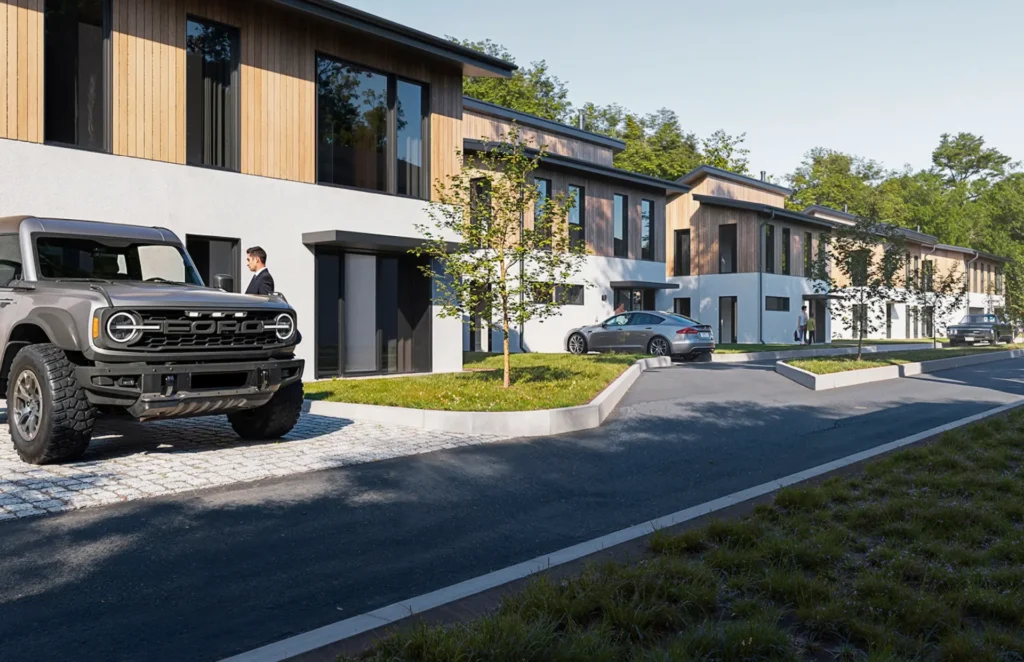
An ADU (Accessory Dwelling Unit) is a secondary home on the same lot as your main house — attached, converted from a garage or basement, or built as a separate structure. A DADU (Detached Accessory Dwelling Unit) is always standalone, typically in the backyard, with its own foundation, utilities and entrance.
The key difference: all DADUs are ADUs, but not all ADUs are DADUs.
In Washington State, both are now more accessible than ever. Under House Bill 1337, most cities in the Greater Seattle Area must allow at least two ADUs per residential lot. In this guide we break down the differences, compare costs and regulations by city, and help you choose what makes sense for your property.
What Is an ADU? Define ADU and Its purpose
If you’re wondering what an ADU is in real estate, the answer is simple. An ADU is a smaller, secondary home built on the same lot as your main house. It gives you extra living space with its own kitchen, bathroom and entrance.
The ADU meaning comes from “Accessory Dwelling Unit.” It can take many forms. Some are attached to the main home, while others come from garage or basement conversions. You can also build a separate unit, though those are often called DADUs, which we’ll explain next.
Today, updated local regulations and building codes make it easier to build an ADU house in many cities. Homeowners use ADUs for steady passive income, housing family members or even creating a home office. If you’re planning a project, working with an experienced ADU builder can help you design a space that fits both your needs and your lot.
What Is a DADU? Understanding DADU meaning
A DADU is a separate living unit built on the same property as your main home. If you’re exploring what DADU in real estate means, it simply means a fully detached space that works as its own private residence.
The DADU meaning stands for “Detached Accessory Dwelling Unit.” Simply put, all DADUs fall under the ADU category but the difference is that a DADU is always a standalone structure, usually located in the backyard.
You may also hear them called a backyard cottage, granny flat, carriage house or in-law suite. These homes are fully self-contained, with a private entrance, kitchen, bathroom and utilities. Homeowners often use them for rental income, housing family members or setting up a quiet workspace. Their independence and versatility make them a smart long-term investment, especially when planned with a professional DADU contractor.
Key differences: DADU vs ADU comparison
When comparing DADU vs ADU, it’s easy to see why people mix them up. They are closely related but the differences matter when planning your project and understanding what fits your lot and goals.
Here’s a clear side-by-side breakdown:
| Feature | ADU (Accessory Dwelling Unit) | DADU (Detached Accessory Dwelling Unit) |
| Structure | Can be attached, converted or detached. | Always a separate, standalone building. |
| Location | Within or attached to the main home. | Usually in the backyard or side yard. |
| Privacy | May share walls or floors. | Full privacy with no shared structure. |
| Construction | Often simpler (garage, basement, addition). | Ground-up construction with foundation and utilities. |
| Cost | More budget-friendly in many cases. | Higher due to full build requirements. |
| Lot Size | Works well on smaller lots. | Needs enough space for a second structure. |
| Rental Income | Good potential. | Often higher due to independence. |
| Zoning Laws | Widely allowed with conditions. | Also allowed in many areas, depending on local zoning. |
In short, both options can boost property value and create additional living space but the right choice depends on your budget, lot size and how much independence you want for the unit.
Benefits of building an ADU or DADU
Both ADU house options and detached units offer real, practical value for homeowners. If your goal is to grow your property potential, adding an accessory dwelling can open up new ways to use your space and earn from it.
Here are some of the biggest advantages:
- Generate passive income by renting out your unit long-term or as a short-term rental where local regulations allow.
- Increase property value, since homes with added living space often sell higher in competitive residential housing markets.
- Support flexible living, whether for aging parents, adult children or guests who need independent living.
- Create functional space for remote work, hobbies or a home office away from your main house.
- Help with housing demand in your area while building a long-term investment asset.
- Adapt over time, using the space as your needs change — from rental to family use or vice versa.
With the right approach, both ADUs and DADUs can deliver steady returns and long-term flexibility. For many homeowners, they’re one of the most practical ways to improve both lifestyle and property value.
ADU and DADU regulations in the Greater Seattle area
Washington State is one of the most ADU-friendly regions in the country. Under House Bill 1337, all cities in urban growth areas must allow at least two ADUs per residential lot, including two detached units. Each city adds its own rules on size, setbacks and parking — here’s a quick overview of the key markets we serve.
| City | Max units per lot | Max DADU size | Parking required | Owner occupancy |
| Seattle | 2 | FAR-based* | No | No |
| Kirkland | 2 | Per state law | Conditional | No |
| Bellevue | 2 | 1,000 sq ft | Conditional | No |
| Redmond | 2 | Lot-dependent | No | No |
| Bothell | 1 | 800 sq ft | Yes (1 space) | Yes |
| Renton | 1 | 600–800 sq ft | No | Yes |
| Issaquah | 1 | 1,000 sq ft | Yes (1 space) | Yes |
| Sammamish | 1 | 1,000 sq ft | Conditional | Yes |
| Edmonds / Shoreline / Kenmore | Updating to HB 1337 | TBD | TBD | Updating |
*Seattle moved from a fixed sq ft cap to Floor Area Ratio in 2025 — size is now governed by overall lot coverage rather than a per-unit square footage limit.
Permit timelines across the region typically run 4–12 weeks. Seattle and Kirkland both offer pre-approved DADU plans programs — Seattle through ADUniverse and Kirkland through its ADU Toolkit — which can reduce permit timelines to 2–6 weeks. Edmonds and several other cities are actively updating their codes to align with state requirements. Rules are evolving — always confirm with your local planning department before starting.
Cost considerations: budgeting for your ADU or DADU project

Building in the Seattle area costs more than generic online calculators suggest. Here are realistic numbers by project type.
Garage or basement conversion (attached ADU) is the most affordable option. It uses an existing structure, which reduces site work and materials. In Seattle and the Eastside, typical budgets run $180,000–$300,000, depending on the condition of the existing structure and the scope of utility upgrades needed.
New detached DADU (backyard cottage) means building from the ground up with a foundation, separate utilities and full interior finishes. In Seattle, the average all-in cost in 2025–2026 runs $400–$650 per sq ft, with total budgets of $400,000–$600,000. On the Eastside — Bellevue, Redmond — expect $450,000–$650,000.
Key factors that move the final number:
- Site complexity — slope, trees, alley access
- Utility connections: $10,000–$30,000
- Permits and inspections: $4,000–$10,000
- Architectural and design fees: 5–15% of construction budget
These ranges reflect current market conditions and align with projects our team has completed across the Greater Seattle Area — you can review examples in our project portfolio.
Financing options typically include HELOCs, construction loans or refinancing. The most important step is getting a detailed line-item estimate from your contractor before signing anything — not just a per-square-foot quote.
Which option is right for your property?
Choosing between DADU vs ADU comes down to a few key factors. Your lot size, budget and long-term goals all play a role in what makes the most sense for your property.
If you have enough yard space — and your city’s zoning permits it — a detached accessory dwelling unit can give you more privacy and stronger rental income potential. It’s also a good fit if you want a separate structure that won’t change your main home’s layout.
An attached ADU works better on smaller lots. It lets you use existing space and often costs less, especially when utilities can be shared. Garage or basement conversions are the most budget-friendly and faster to complete, making them a smart option if you want to minimize construction time and upfront cost.
In the end, your choice should match your goals, whether that’s passive income, family housing or boosting property value. Working with experienced professionals helps you fully understand your property potential before you start.
The ADU and DADU construction process

Building an ADU or DADU starts with a clear plan and realistic expectations. The process begins with design and planning — your contractor evaluates the site, develops layouts and ensures everything aligns with local zoning laws and building codes. Once plans are ready, they are submitted for permits. In the Greater Seattle Area, approvals typically take 4–12 weeks depending on the city and project complexity, though pre-approved plans in Seattle and Kirkland can shorten this significantly.
After permits are approved, construction moves forward. The site is prepared, utilities are set up and the foundation is built. From there, the structure takes shape with framing, plumbing, electrical and interior finishes. A new detached accessory dwelling unit typically takes 6–12 months total from permit approval to move-in. Final inspections ensure the space meets all local regulations before rental use or occupancy. Working with experienced builders helps keep the process on schedule and avoids costly mid-project surprises.
Maximizing rental income from your ADU or DADU
Seattle’s rental market makes ADU and DADU investments particularly attractive. With the city’s median rent sitting around $2,000–$2,200 per month for a one-bedroom unit, a well-finished accessory dwelling can generate serious returns.
In practice, rental income varies by unit type and location:
- Attached ADU or basement conversion: $1,500–$2,200/month depending on size and neighborhood
- Detached DADU (backyard cottage): $2,400–$3,900/month in most Seattle neighborhoods, with premium areas like Ballard, Queen Anne and Capitol Hill reaching the higher end
- Short-term rental (where local zoning allows): $150–$200/night average, which can outperform long-term leases in high-demand neighborhoods near employment centers
On the Eastside — Bellevue, Redmond, Kirkland — tech-sector demand keeps rents strong. A finished DADU in these markets typically commands $2,500–$3,500/month, driven by remote workers and families seeking multigenerational living arrangements.
A few things that directly affect how much your unit earns: separate utilities, off-street parking, in-unit laundry and quality finishes all raise rental value and reduce vacancy. Long-term tenants offer stability; short-term rentals offer a higher ceiling but require more active management. Either way, rental income is taxable in Washington State, though eligible expenses — utilities, maintenance, depreciation — can offset that.
Most owners working with realistic Seattle-area construction budgets see break-even within 8–12 years, with the unit continuing to generate income long after.
How ADUs and DADUs impact home resale value

In Seattle’s competitive real estate market, a permitted ADU or DADU is a tangible financial asset — not just extra square footage. Homes with accessory dwelling units typically see a 15–20% increase in overall property value, which on a $1M Seattle property translates to $150,000–$200,000 in added equity.
The appraiser’s calculation goes beyond just size. A unit with proper permits, rental history and independent utilities is valued more like a second income-producing property than a simple addition. In practice, a well-finished DADU can add $150,000–$300,000 to total appraised value depending on size, finish level and neighborhood.
One development worth knowing: as of 2025, Seattle allows DADUs to be subdivided and sold separately as condominium units with their own title. In premium neighborhoods like Queen Anne, Ballard and Capitol Hill, standalone DADUs have sold for an average of $750,000. This opens up an exit strategy that didn’t exist a few years ago — build, rent, then sell the DADU independently if your needs change.
Properties with ADUs also tend to attract a wider buyer pool: investors looking for rental income, families planning for multigenerational living and buyers who want a dedicated home office. That broader demand typically means faster sales and stronger offers.
The one thing that consistently hurts resale value is unpermitted work. Buyers and lenders flag it, appraisers discount it and it can stall or kill a sale. Building with proper permits from day one protects both the rental income during ownership and the sale price when you’re ready to move on.
What buyers look for in properties with ADUs
In the Greater Seattle Area, buyers who actively search for properties with accessory dwelling units know what they want — and what they want to avoid. Understanding these priorities helps you build something that holds its value at resale, not just during ownership.
Permits and final inspections come first. In King County, an unpermitted unit can complicate financing, trigger required remediation costs and reduce the appraised value of the property. Building to code from day one is the only way to protect the investment long-term.
Rental history adds credibility. If the unit has been leased, buyers want to see it. Documented income — even 12 months of lease agreements — turns “potential rental income” into a proven asset. This matters especially to investor buyers, who are a significant portion of the ADU market in Seattle.
Independence raises value. Separate utilities, a private entrance and off-street parking all make a unit more desirable to both tenants and future buyers. On the Eastside, where tech-sector buyers often purchase with multigenerational living or home office use in mind, these features are frequently non-negotiable.
Finish quality should match the main home. A unit that feels like an afterthought — mismatched materials, low ceilings, poor natural light — drags down buyer perception of the entire property. The best-performing ADUs in Seattle’s resale market are ones where the design was considered alongside the main house, not bolted on after the fact.
Partner with Maksymov Brownstone LLC for your ADU or DADU project
Building an ADU or DADU in the Greater Seattle Area means navigating city-specific zoning rules, permit timelines that vary by municipality and construction costs that look very different from national averages. Getting it right requires a team that works in this market every day — not just general contractors who occasionally take on accessory dwelling projects.
Maksymov Brownstone has deep hands-on experience with ADU and DADU construction across King and Snohomish counties, from Seattle and Bellevue to Kirkland, Redmond, Bothell and beyond. That means we know which cities offer pre-approved plans, where permit timelines run long and how to design a unit that meets local code while maximizing your return.
We handle the full process — site evaluation, design, permitting and build — with clear timelines and detailed estimates from the first conversation. No vague per-square-foot quotes, no surprises mid-project.
If you’re ready to explore what’s possible on your property, start with our ADU construction service or DADU construction service pages — or reach out directly and we’ll walk you through the options for your specific lot and city.