Yes. Under Washington’s HB 1337, cities and counties can no longer prohibit a homeowner from selling a DADU as its own condominium unit, separate from the main house — and they can no longer require you to live in either unit as a condition of doing so. That said, “the law allows it” and “you can list it tomorrow” are two different things. Selling a DADU separately still requires going through a legal process called condoization, and it’s worth understanding what that process actually involves before you build around it as an exit strategy.
The Short Answer: Yes, Washington Law Allows It (HB 1337)
House Bill 1337 was signed into law in 2023 and amended the state’s Growth Management Act, taking full effect across most jurisdictions on a rolling compliance schedule through 2025. Two provisions matter most if you’re thinking about selling a DADU:
- Cities and counties cannot prohibit the sale of an ADU or DADU as a condominium unit independent of the principal unit. In plain terms: a local jurisdiction can’t tell you the DADU has to stay bundled with the main house forever.
- No owner-occupancy requirement. Older ADU rules in many Washington cities required the property owner to live in the primary home or the ADU. HB 1337 struck that down statewide — you don’t have to live in either unit to build, rent, or sell one separately.
These provisions are codified in state law under RCW 36.70A.681 and 36.70A.682. What HB 1337 does not do is hand you a finished sale. It removes the legal barrier that used to let cities block this outright — the actual mechanics of separating ownership still have to go through a defined process, covered below.
Condo Conversion vs. Unit Lot Subdivision: Two Different Legal Paths
This is where a lot of DADU owners get confused, because both paths lead to “I can sell the DADU on its own” — but they’re legally different mechanisms with different requirements.
Condominium conversion (condoization) doesn’t split the land itself. The underlying lot stays under shared ownership through a condominium association, governed by a recorded Condominium Declaration. What becomes separately owned and separately sellable is the structure — the house and the DADU each get their own title, while the land beneath them remains a shared asset managed by the association.
Unit lot subdivision is a true land division: the parcel itself gets split into two or more separate legal lots, each with its own title and its own land, not just a structure sitting on shared ground. This is a more involved process and generally requires enough lot area and frontage to meet subdivision standards.
For most existing Seattle DADU lots, condoization is the practical path. Seattle’s typical single-family lots are too small to qualify for a true subdivision under the city’s land-use code, which is exactly why condominium conversion — not subdivision — has become the default route homeowners use to sell a DADU separately in the city. If you’re evaluating which path applies to your property, that distinction is the first thing to confirm, since it changes what you’re actually selling: a unit with shared land interest, versus a genuinely independent parcel.
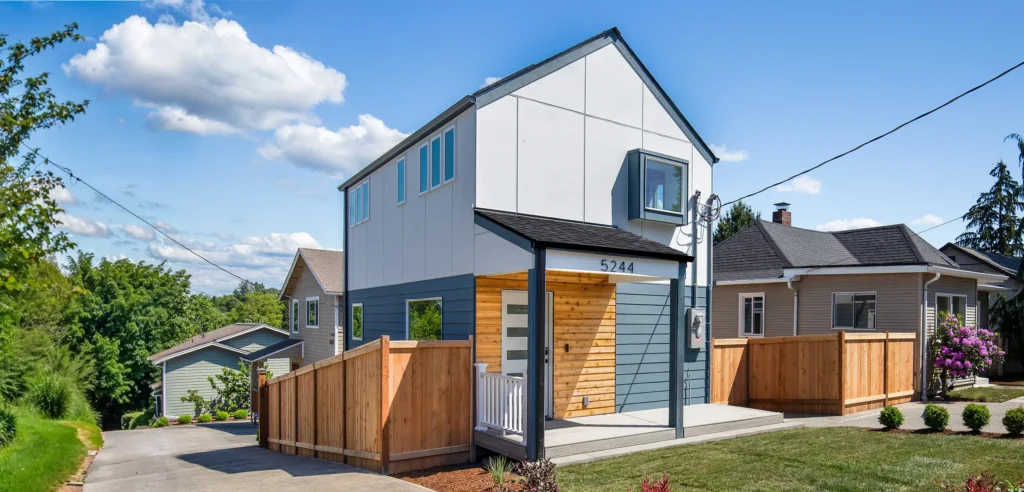
How DADU Condoization Actually Works in Seattle
At a high level, converting a completed DADU into a separately sellable condominium unit follows this sequence:
- The unit is complete and holds a Certificate of Occupancy. Condoization is a process for something that’s actually been built, not a set of approved plans.
- A licensed surveyor prepares a survey and site plan documenting the boundaries of each unit and the shared elements of the lot.
- An attorney drafts the Condominium Declaration, the legal document that creates the condominium association, defines each unit, and spells out the common elements (land, shared utilities, access, etc.) that remain jointly owned.
- The documents are recorded with the county and reviewed by Seattle’s Department of Construction and Inspections (SDCI) as part of the process.
- Separate titles are issued for the principal residence and the DADU, at which point each can be financed, transferred, or sold independently.
Because a mortgage lender has a financial interest in the property as a whole, if there’s an existing loan on the primary residence, its lender typically needs to be involved before the property can be legally split into separate condominium units. Given the number of parties involved — attorney, surveyor, county recording, SDCI review, and potentially your lender — timelines vary property to property. It’s worth getting a specific estimate from a condo attorney and SDCI before you build a sale timeline around it.
What HB 1337 Does Not Override
HB 1337 removed a major legal barrier, but it didn’t clear away everything else that applies to your property. A few things to keep in mind:
- Local short-term rental rules still apply. HB 1337 eliminated owner-occupancy requirements, but it didn’t stop cities from separately regulating Airbnb-style rentals. Some jurisdictions have adopted their own restrictions on short-term rental use for detached ADUs, independent of the sale question.
- Critical areas and shoreline regulations are unaffected. If your property is near a lake, wetland, or other environmentally critical area, those review requirements still apply regardless of HB 1337.
- Seattle’s tree protection code still applies, as do standard building, plumbing, electrical, and energy code requirements — HB 1337 changed zoning and ownership rules, not construction code.
- Pre-existing covenants and HOA restrictions may still carry weight, depending on when they were created and what they cover. HB 1337 limits new restrictive covenants from blocking ADUs, but older agreements can be more complicated.
- You still need to confirm feasibility with SDCI and a condo attorney before you count on it. The law creates the right; it doesn’t pre-approve your specific lot, structure, or timeline.
What This Means If You’re Planning to Build in Order to Sell
HB 1337 is the reason a “build-to-sell” DADU strategy is legally possible in Seattle at all — without it, you’d be stuck holding the unit as a rental or keeping it bundled with the main house indefinitely. But the legal green light is the starting point, not the whole plan. Before you build around a sale-based exit, it’s worth working through two more questions: what the build itself will realistically cost, and how to finance it so the loan is structured around a sale rather than years of rental income.
For the financing side — construction loans, HELOCs, and structuring your loan around a sale-based exit — see our guide on financing a build-to-sell DADU.
FAQ
Can you sell a DADU separately from your house in Seattle? Yes. Washington’s HB 1337 prohibits cities and counties from banning the sale of a DADU as a separate condominium unit from the principal residence. In Seattle, this is typically done through condominium conversion rather than a full lot subdivision, since most existing lots are too small to subdivide.
Do you need owner occupancy to sell an ADU in Washington? No. HB 1337 eliminated owner-occupancy requirements statewide, so you don’t have to live in the primary home or the ADU to build, rent, or sell either unit separately.
What’s the difference between condo conversion and unit lot subdivision for a DADU? A condominium conversion keeps the land under shared ownership through a condo association and separates only the structures for sale. A unit lot subdivision actually splits the parcel into separate legal lots with independent land titles. Most Seattle DADU properties use condo conversion because their lots don’t meet subdivision requirements.
Can I sell my mother-in-law unit or backyard cottage separately? If it’s a legally permitted DADU, generally yes, following the same condoization process — completed construction, survey, recorded condominium declaration, and separate titles. The unit needs to be a permitted structure, not an informal or unpermitted conversion.
Does HB 1337 apply to my property if I’m outside Seattle city limits? HB 1337 applies statewide within urban growth areas, with jurisdictions required to comply on a rolling schedule. Rules and local processes vary by city and county, so it’s worth confirming current requirements with your local planning department.
Can HOA rules or covenants still block a DADU sale? It depends on when the covenant was created and what it restricts. HB 1337 limits how new restrictive covenants can block ADUs, but older agreements can be more complicated — this is worth reviewing with an attorney if your property is part of an HOA.